Why Enterprises Are Making the Move in 2026
Posted on April 6, 2026 by DEFTeam Data Science Experts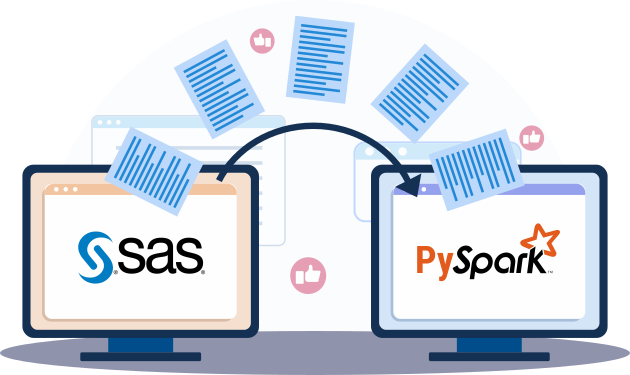
For years, SAS has been the backbone of enterprise data analytics - especially in healthcare, finance, and government sectors. It has served organizations well. But in 2026, a growing number of US enterprises are making a decisive move: migrating their SAS workloads to PySpark. The reasons are no longer just about cost. They are about staying competitive in a world where data volumes are exploding and the pace of analytics is accelerating.
At DEFTeam, we have been at the center of this shift. Through our automated SAS to PySpark migration solution, we have helped enterprises make this transition faster and with significantly less risk than traditional manual approaches. In this post, we share what is driving this migration wave - and what makes it more achievable today than ever before.
Why Enterprises Are Moving Away from SAS
The decision to migrate from SAS is rarely made overnight. It usually follows months - sometimes years - of mounting pressure from three directions: cost, scalability, and talent availability.
- Rising License Costs:
SAS licensing is one of the most significant recurring expenses in an enterprise analytics budget. Organizations that have grown their SAS footprint over the years often find themselves locked into costly annual renewal cycles with limited room to negotiate.
- Scalability Limits:
SAS was not designed for the data volumes that modern enterprises handle. As organizations move to cloud-native data platforms and face terabytes - or petabytes - of data, SAS begins to show its limitations. PySpark, built on Apache Spark, handles distributed big data workloads natively.
- Talent Gap:
The pipeline of SAS developers is shrinking. Senior SAS programmers are retiring, and the new generation of data engineers builds primarily on Python and Spark. Finding and retaining SAS expertise is becoming increasingly expensive and difficult.
- Ecosystem Lock-in:
SAS operates as a closed ecosystem. It does not integrate easily with modern cloud services, machine learning frameworks, or the open-source data tools that most organizations are building around today.
The business case is clear: Organizations that migrate to PySpark eliminate recurring SAS license costs entirely, gain access to a far larger talent pool, and position their analytics infrastructure to scale without limits on cloud platforms like AWS, Azure, and GCP.
Why SAS to PySpark Migration Has Historically Been Risky
If the benefits are so compelling, why have many enterprises hesitated? The answer is risk. SAS programs - especially in healthcare and finance - encode years of business logic, regulatory compliance rules, and carefully validated analytical workflows. The fear of breaking something in translation is real and legitimate.
Traditional SAS to PySpark migration was a manual process. Developers had to read SAS code line by line, understand its intent, and rewrite it in PySpark. For organizations with hundreds or thousands of SAS programs, this was a multi-year project with a significant risk of introducing errors. Even a small difference in how a statistical calculation was expressed could produce different outputs - and in healthcare or finance, that matters enormously.
This is the problem DEFTeam set out to solve.
DEFTeam's Automated Migration Solution - A Smarter Approach
DEFTeam's automated migration solution changes the equation entirely. Instead of rewriting SAS programs manually from scratch, our solution reads the SAS source code, understands its structure, and automatically generates equivalent PySpark pipelines that produce the same outputs.
The key distinction from a manual approach is that the automated conversion handles the most common - and most tedious - SAS patterns that make up the bulk of enterprise workloads:
- DATA Step conversions:
The core of most SAS programs - data loading, transformations, conditional logic, and output routing - is handled automatically, preserving the original business logic.
- MERGE and BY-group processing:
Complex SAS MERGE operations with BY-group aggregations - including FIRST. and LAST. processing - are converted to equivalent Spark operations.
- PROC SORT:
Sorting operations with multiple BY keys and deduplication options are mapped directly to sorted Spark DataFrames.
- IF-THEN-ELSE and control flow:
Conditional logic, DO loops, and branching patterns within DATA steps are converted accurately.
- Variable operations:
Arithmetic, comparison, logical operators, KEEP, DROP, RENAME, and running total patterns are all handled systematically.
No silent data loss: One of the most important qualities of DEFTeam's approach is that even for SAS constructs that cannot be fully converted automatically, the solution still produces a partial PySpark file - annotated with the original SAS code for human review. Nothing is silently dropped or ignored.
Manual vs Automated Migration - What Changes
| Criteria | Manual SAS Migration | DEFTeam Automated Migration |
|---|---|---|
| Migration Speed | Months to years | Weeks |
| Output Accuracy | Depends on developer skill | 99% validated accuracy |
| Business Logic Preservation | High risk of drift | Preserved automatically |
| Handling of Complex SAS Patterns | Varies by developer | Systematic, documented |
| Traceability | Hard to audit | Original SAS preserved as reference |
| Business Continuity | Significant disruption risk | SAS stays live until PySpark validated |
The Human-in-the-Loop Difference
Automation alone is not enough - and DEFTeam knows this. That is why our migration approach combines automated conversion with expert human validation at every stage. After the automated tool generates PySpark equivalents, our data engineers review each converted module, running side-by-side comparisons between the original SAS outputs and the new PySpark results.
This Human-in-the-Loop process is what enables DEFTeam to guarantee 99% output accuracy. The automation handles the volume; the experts handle the edge cases. Together, they deliver a migration that organizations can trust - especially in regulated industries like healthcare where data accuracy is not negotiable.
What Your Team Does Not Have to Worry About
One of the most common concerns we hear from organizations considering a SAS to PySpark migration is: "What about all the business logic our team built over the years? We cannot afford to lose that."
This is exactly the concern DEFTeam's migration approach addresses. Because the automated solution reads the original SAS code and converts it - rather than replacing it from scratch - the business logic encoded in your existing SAS programs is preserved. Your team does not need to re-document or re-explain years of analytical logic. It travels with the migration.
- Data transformation rules carry over automatically
- Conditional business logic is preserved in equivalent PySpark form
- Group-level calculations and aggregations produce the same results
- Sorting and deduplication behaviors are maintained
- Original SAS code is retained as a reference alongside the converted PySpark
Is Your Organization Ready to Make the Move?
The SAS to PySpark migration decision ultimately comes down to one question: how long can your organization afford to keep paying SAS licensing costs while competitors on open-source platforms scale faster and spend less?
The good news is that the migration no longer has to be the years-long, high-risk project it once was. With an automated migration approach, the right partner, and a structured validation process, organizations are completing migrations that once seemed daunting - in a fraction of the time.
If you are evaluating a SAS to PySpark migration, the right first step is a migration assessment. DEFTeam will review your existing SAS codebase, identify the scope of your migration, and provide a clear timeline and plan - at no obligation.
Let DEFTeam Guide Your SAS to PySpark Migration
Whether you are migrating a handful of SAS programs or thousands of production workloads, DEFTeam's automated migration solution reduces the time, cost, and risk of moving to PySpark. Our experts have completed 30+ enterprise SAS migrations with 99% output accuracy. Contact DEFTeam today to schedule your free migration assessment.